
Gramado and Italian Immigration: the history behind old-fashioned photos
Before it was the town of hydrangeas, Gramado was an Italian colony called Linha Nova. And the studio portrait, taken in the family's best clothes, was the only image many of those families ever left behind.
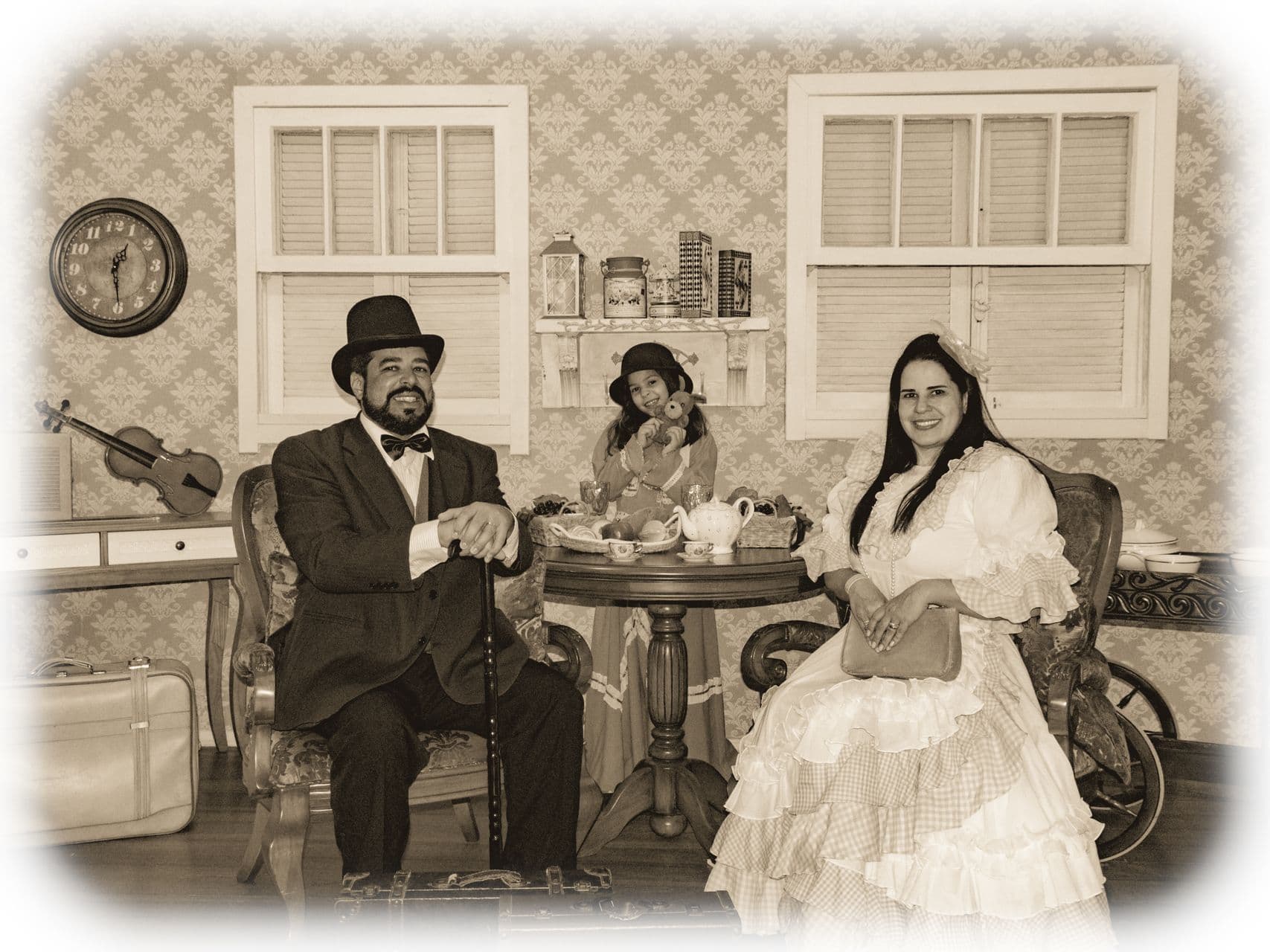
Anyone arriving in Gramado today finds half-timbered façades, chocolate and hydrangeas — a town that presents itself to the world with a German accent. But the name of the municipality was born in a place called Linha Nova, and Linha Nova was an Italian colony.
That's the part of the history that barely fits on a postcard. It explains the surnames of the countryside, the cantinas of the valley — and, what interests us here, it also explains why there is a tradition of studio portraiture in the Serra Gaúcha, which is exactly what gets remade when someone asks for an old-fashioned photo.
1875: Italy lands in Rio Grande do Sul
The landmark of Italian immigration in Brazil is 1875. That year the first families began arriving at the colonies the government had opened in the north-east of Rio Grande do Sul: Conde d'Eu (today Garibaldi), Dona Isabel (Bento Gonçalves) and Campo dos Bugres (Caxias do Sul).1
Most came from Veneto, Lombardy and Trentino — regions that, in newly unified Italy, were going through a severe agrarian crisis. What awaited them here was dense forest, plots measured in straight lines and the obligation to fell the trees before planting anything.
In that same 1875, the region where Gramado stands today received its first known settlers: José Manoel Corrêa and Tristão José Francisco de Oliveira, of Portuguese-Azorean descent, who settled there with their families.2
The town, then, does not begin Italian. It begins to become Italian ten years later.
1885: Linha Nova, where Gramado actually began
Once the first decade had passed, the plots of the original colonies were no longer enough. The children of those immigrants began to spread out into the neighbouring lands looking for space — and some of them went up towards what is now Gramado.
The zero milestone is 1885, in Linha Nova, with the arrival of the Boff family.3
It isn't a footnote in the municipality's history: it's its address of origin. The official chronology shows why.
| Year | What happened |
|---|---|
| until 1904 | The region belonged to Taquara do Mundo Novo, today's Taquara |
| 19/04/1904 | The territory becomes the 3rd District of Taquara, seated in Linha Nova |
| 17/01/1913 | Municipal Act nº 139 changes the district's name from Linha Nova to Gramado |
| 15/12/1954 | State Law nº 2,522 separates Gramado from Taquara and raises it to a municipality |
Germans and Italians in the same territory
In the final years of the 19th century came the German-Brazilians — children and grandchildren of the German immigrants who had already been in Rio Grande do Sul for half a generation. They brought the architecture, the joinery and much of the aesthetic that tourism turned into the town's visual identity.
Gramado formed with both inheritances at once, and with several others alongside: before all of them, the Indigenous peoples; then Luso-Brazilians, enslaved Afro-Brazilians, Azoreans; and later Poles, Austrians, Syrian-Lebanese, Spaniards.
The division that stuck is almost geographical. The centre tells the German story. The countryside — Linha Nova, Linha Bella, Linha 28, the Vale do Quilombo — tells the Italian one, with cantinas, vineyards and chapels still standing.
The 1921 railway and the arrival of tourism
In 1921 the railway reached Gramado, on the branch that climbed the range from Taquara.6 That's what connected the colony to the rest of the state without depending on dirt roads.
The effect was twofold. The countryside's produce began to flow out; and Porto Alegre discovered that there was, a few hours away by train, a cool place in summer. The vocation as a summer resort — which would become today's tourism — starts there.
The studio portrait: the only image these families left
Here history meets photography.
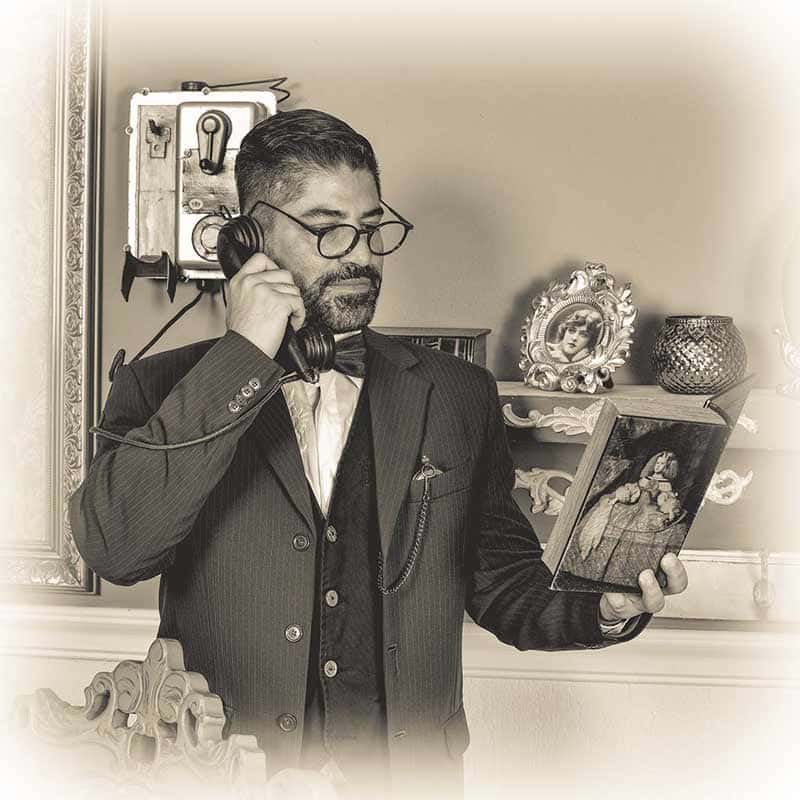
A settler family of the late 19th century had no visual record of itself. There was no camera at home, no album. The only image many of these families produced in their entire lives was a studio portrait — taken once, with everyone gathered, and then framed on the wall.
And the studios existed because they came along too: many of the first photographers established in the region were Italian immigrants who brought the trade in their luggage or learned it here.7
The best-known case is Giacomo Geremia. Born in 1880 in San Martino di Lupari, province of Padua, around 1905 he opened a small studio in Antônio Prado and also served the countryside, travelling to the families. By 1911 he was in Caxias do Sul, where he founded the Atelier Photographico Geremia, on Avenida Júlio de Castilhos. He specialised in portraiture and was the town's first photographer to use artificial light.8
The Studio Geremia collection — more than eight thousand negatives on glass and film — was acquired by Caxias do Sul city hall in 2002 and is held at the João Spadari Adami Municipal Historical Archive.9 It is one of the most complete records of Italian immigration in Rio Grande do Sul, and it consists almost entirely of portraits: couples on their wedding day, whole families posed, children at their first communion, young men before leaving for military service.
Why the clothing and the pose mattered so much
Looking at those photos today, the stiffness stands out. Nobody smiles. Everyone is impeccably dressed. Hands are still, shoulders straight, gaze fixed on the lens.
There was a technical reason: exposure times were long, and moving blurred the image. But there was a bigger reason, and it isn't technical.
That's why nobody posed in work clothes. People wore the best they had: Sunday and wedding clothes, often the only good outfit in the house. The serious pose wasn't a lack of joy — it was formality, the same with which one signs a document.

Where to see this history in Gramado today
If you're in town and want to leave the central circuit, two routes lead straight to that origin:
- Linha Bella — the road that crosses the Italian communities of Gramado's countryside, passing the Zero Milestone in Linha Nova. More than twenty families open their properties to visitors, among cantinas, wineries and small-farm production.10
- Caminhos de Caravaggio — the pilgrimage routes linking the two sanctuaries of Our Lady of Caravaggio, in Canela and in Farroupilha: about 200 km in ten sections, passing through Canela, Gramado, Nova Petrópolis, Caxias do Sul and Farroupilha.11
In 2025 Italian immigration to Brazil completed 150 years, and Gramado raised tributes to the date — which brought much of this history back into public conversation.12
Remaking the portrait
That's where what we do in the studio comes from.
An old-fashioned photo isn't a photo with a sepia filter. It's the reconstruction of a gesture: putting on the period costume, taking up the formal pose, looking into the lens the way people looked when photography was an event — and leaving with an image that resembles the ones hanging on your great-grandmother's wall.
For those with Italian roots in the Serra, and there are many, the effect is very specific. The photo doesn't end up looking like a generic old photo. It ends up looking like that photo: the one of the settler couple, taken once in a lifetime, in the best clothes they had.
And that, in the end, is why the period portrait still makes sense 140 years after the first families arrived in Linha Nova. It isn't nostalgia for any era. It's the continuation of a habit those families invented out of necessity: stopping everything, gathering everyone, and recording who you are now — for whoever comes after.
Perguntas frequentes
Was Gramado colonised by Germans or by Italians?
What is Gramado's Linha Nova?
When did Gramado become a municipality?
Why does nobody smile in old photos?
What is an old-fashioned photo?
Referências
- Italian immigration in Rio Grande do Sul — the Conde d'Eu, Dona Isabel and Campo dos Bugres colonies, from 1875 onwards. Wikipédia; see also 140 years of Italian immigration in RS (UCS, e-book). ↩
- First settlers of the Gramado region, around 1875. First inhabitants of Gramado. ↩
- Zero milestone of Italian colonisation in Gramado: 1885, in Linha Nova, with the Boff family. An attraction that takes tourists to the Italian communities where the town began. ↩
- Taquara's 3rd District seated in Linha Nova (19/04/1904) and Municipal Act nº 139, of 17/01/1913, which renamed the district Gramado. Beyond the 65: a short history of the 5th District of Taquara do Mundo Novo. ↩
- State Law nº 2,522, of 15/12/1954; the 1953 plebiscite and the first mayor taking office in 1955. Gramado turns 70: historical facts. ↩
- The railway reaching Gramado in 1921. Gramado — Wikipedia. ↩
- On the region's first photographers, largely Italian immigrants. A short history of photography in Caxias do Sul. ↩
- Giacomo Geremia (San Martino di Lupari, 1880 — Caxias do Sul, 1966); studio in Antônio Prado around 1905 and the Atelier Photographico Geremia in Caxias do Sul from 1911. Historical-Biographical Dictionary of Photography (LABHOI/UFF); Wikipédia. ↩
- Studio Geremia collection: more than eight thousand glass and film negatives, acquired by the municipality in 2002. João Spadari Adami Municipal Historical Archive — Studio Geremia Collection. ↩
- The Linha Bella route, in Gramado's countryside. Linha Bella Gramado. ↩
- Caminhos de Caravaggio: about 200 km in ten sections, through five municipalities. Visit Gramado — Caminhos de Caravaggio. ↩
- 150 years of Italian immigration to Brazil, in 2025. Gramado raises a tribute. ↩